
Magnetic Job Ticket Holders:
Surface Compatibility, Load Guidance & Mounting Options
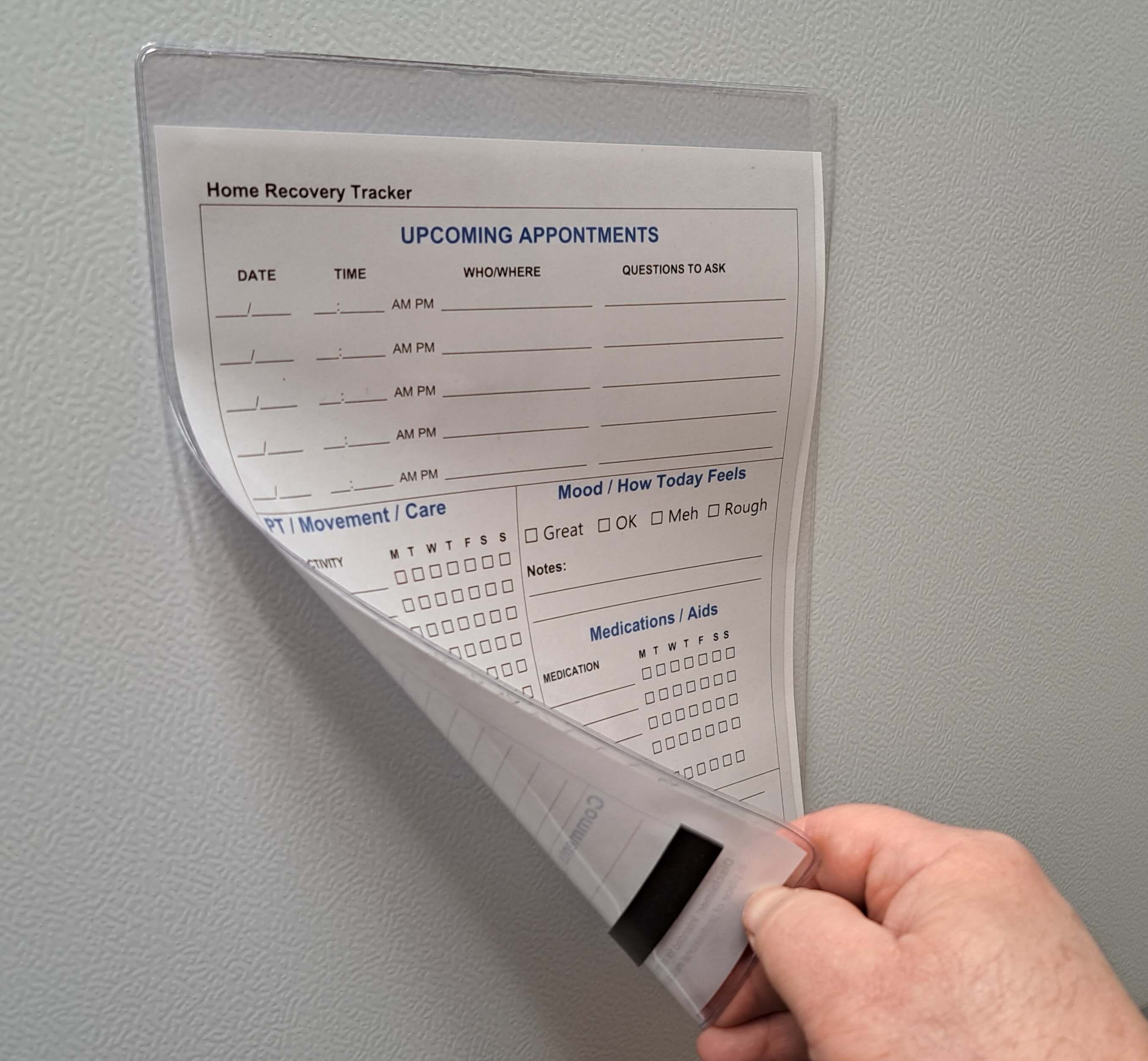
Magnetic job ticket holders are a convenient way to place work orders, instructions, inspection sheets, schedules, and other paperwork directly on machinery, cabinets, shelving, carts, racks, and workstations without drilling holes or applying permanent adhesive.
The first question is whether the mounting surface will accept a magnet. The second is whether the holder, magnetic backing, and surface can support the intended contents in actual use.
For ordinary paperwork on a clean, flat steel surface, magnetic mounting is usually straightforward. Heavier packets, expandable pockets, binders, tools, plates, stencils, samples, vibration, or unusually large holders require more consideration.
What Surfaces Work with Magnetic Document Holders?
Magnetic holders work best on clean, flat steel or iron surfaces with strong magnetic attraction.
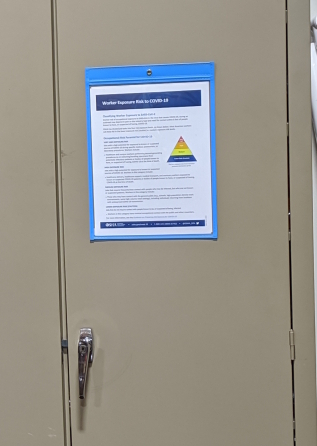
Common examples include steel machinery panels, cabinets, warehouse racks, shelving, carts, lockers, toolboxes, doors, and workstations.
The important distinction is that metal does not automatically mean magnetic. Aluminum, copper, brass, and many stainless steels may look similar to steel in a workplace but behave very differently with magnetic backing.
| Material | Typical Magnetic Holder Compatibility |
|---|---|
| Carbon / mild steel | Good to excellent |
| Iron | Good to excellent |
| Ferritic stainless steel | Often good |
| Martensitic stainless steel | Often magnetic |
| Austenitic stainless steel | Often weakly magnetic or non-magnetic |
| Aluminum | No useful attraction |
| Copper | No useful attraction |
| Brass | No useful attraction |
| Plastic | No |
| Wood | No |
| Glass | No |
| Fiberglass | No |
| Drywall | No |
| Masonry | No |
These are practical categories rather than material certifications. Alloy, steel thickness, coatings, surface condition, and the amount of direct contact can all affect the result.
What About Stainless Steel?
Stainless steel deserves separate attention because it is a family of alloys rather than one single material.
Ferritic and martensitic stainless steels are generally magnetic. Many austenitic grades are weakly magnetic or effectively non-magnetic for this type of application. Duplex stainless steels contain both ferritic and austenitic structures and can show magnetic attraction as well.
That is why a magnetic holder can work well on one stainless-steel machine or cabinet and poorly on another.
In day-to-day use, knowing the exact stainless grade is often less important than testing the actual surface.
A Simple Surface Test
An ordinary refrigerator magnet or piece of flexible magnetic strip is enough for a quick check.
- Place the magnet directly against the intended mounting surface.
- Make sure it attaches firmly rather than barely clinging.
- Slide it vertically and sideways to judge how easily it moves.
- Test more than one area if the equipment has seams, coatings, curved panels, or different materials.
If a small magnet barely stays attached, a loaded document holder is unlikely to be a good candidate for a standard magnetic configuration.
For an important or unusual application, testing an actual holder sample is more useful than guessing from the material description.
What Affects How Well a Magnetic Holder Stays in Place?
Once the surface has been confirmed as magnetic, several practical factors determine how well the finished holder performs.
Surface Flatness
Flexible magnetic strip works best when it can lie flat against the mounting surface. Curved, corrugated, embossed, or heavily textured panels reduce direct contact.
Paint and Coatings
A normal painted steel cabinet may work very well, but any material between the magnetic strip and the steel creates separation.
Heavy paint, powder coating, protective films, labels, rust, or other layers can reduce magnetic holding strength.
Dirt, Oil, and Debris
Dust, metal chips, grease, oil, and other contamination can keep the magnetic backing from sitting flat against the surface. Cleaning both surfaces can make a noticeable difference.
Holder Size
Larger holders create more leverage and have more opportunity to flex. The farther the loaded pocket projects away from the mounting surface, the more important backing rigidity and magnetic strip placement become.
Magnetic Strip Area and Placement
Additional magnetic material can improve holding performance, but simply adding magnet area is not the whole answer. Where the magnetic strips are placed across the back also affects how the holder supports its load.
Weight Distribution
A broad packet of paper spreads its weight over much of the pocket. A dense object concentrated near one edge can create considerably more stress even if the total weight is similar.
Vibration and Movement
A holder mounted on a stationary cabinet is an easier application than one mounted on vibrating machinery, a moving cart, or a door that is repeatedly opened and closed.
How Many Sheets Can a Magnetic Job Ticket Holder Carry?
There is no single sheet-count rating that applies to every magnetic document holder, but useful working ranges can be established for typical applications.
Standard Single-Pocket Magnetic Holders
For a typical single-pocket, non-expandable magnetic job ticket holder mounted on a good flat steel surface, a standard magnetic configuration is commonly suitable for approximately:
5 to 10 sheets of ordinary paper
The actual result depends on holder size, paper weight, magnetic strip area and placement, coatings, vibration, and the mounting surface.
A small packet on a stationary cabinet is an easy load. The same holder carrying heavy tag stock, rigid inserts, or dense contents on operating machinery is not equivalent.
Expandable Magnetic Document Pockets
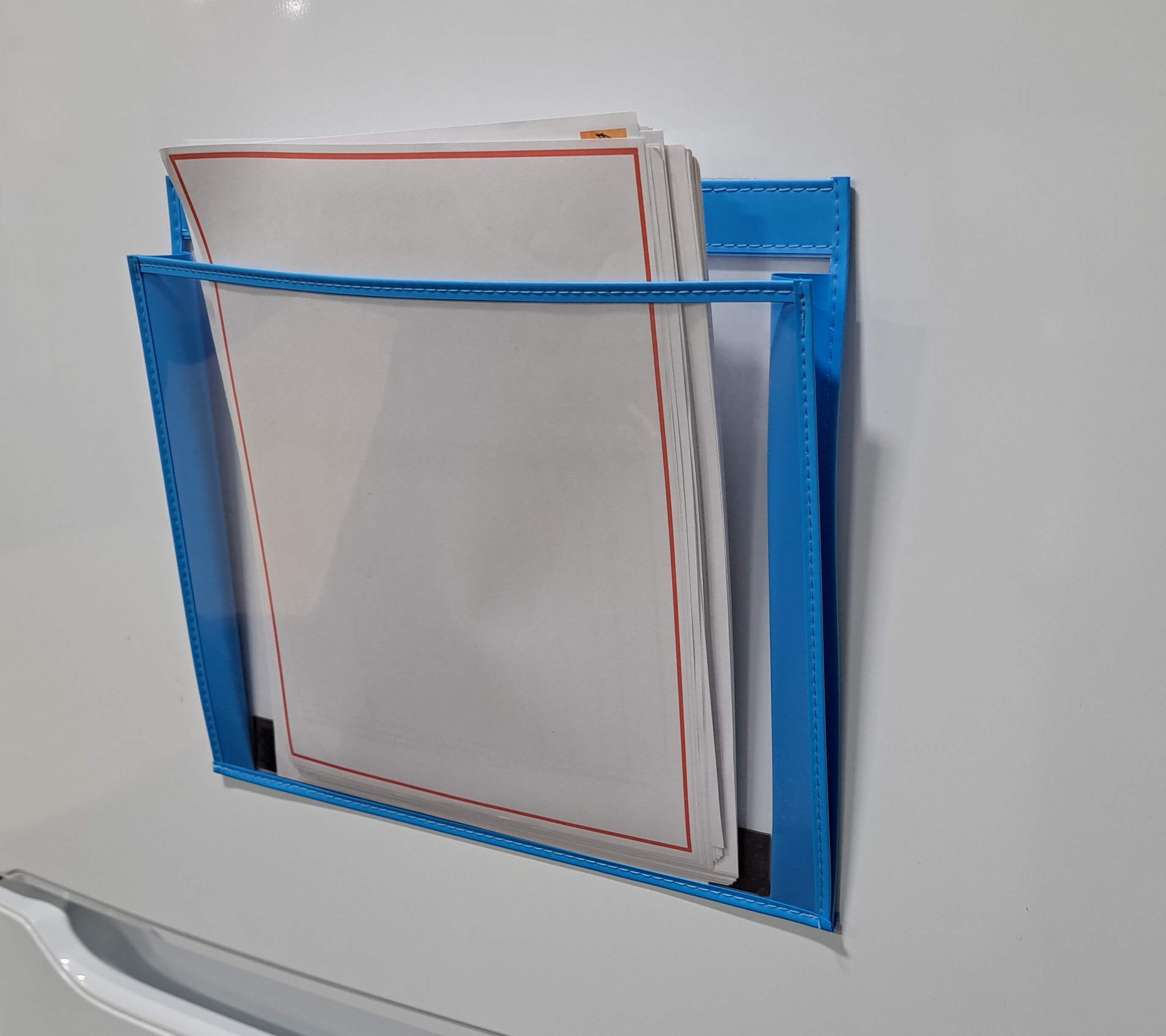
Expandable document pockets are built to carry thicker packets. As the pocket fills, both weight and pocket depth increase.
The load also moves farther away from the mounting surface, creating more leverage on the magnetic backing.
Expandable magnetic designs therefore commonly use additional magnetic strip area compared with a standard single-pocket holder.
A properly configured expandable magnetic pocket may be suitable for approximately:
30 to 50 sheets of ordinary paper
The additional magnetic area helps support the heavier and deeper packet.
Heavy Contents Are Different from Paper
Paper sheet count should not be used to judge an application involving dense, rigid, or unusually shaped contents.
Examples include:
- Metal stencils
- Metal plates
- Small tools
- Machine parts
- Wood sheets
- Plastic or material samples
- Thick manuals
- Three-ring binders
- Catalogs
- Gauges
- Templates
- Inspection tools
A flat paper packet spreads its load across the pocket. A wrench, steel plate, binder, or wood sample may put much of its weight along the bottom or in one small area.
This can cause the holder to sag, slide, peel away from the surface, or bow.
For those applications, the useful information is the actual object, approximate weight, holder dimensions, mounting surface, and orientation.
Can a Magnetic Pocket Hold a Three-Ring Binder?
It can be possible, particularly with an expandable holder designed for the application, but a binder creates a much more demanding load than ordinary paperwork.
A loaded binder is heavier, extends farther away from the mounting surface, and places much of its weight near the bottom of the pocket.
Depending on the binder and mounting conditions, the holder may need:
- Additional magnetic strips
- Wider magnetic strips
- Different strip placement
- Greater total magnetic area
- Reinforced construction
- A rigid or semi-rigid back
- A mechanical mounting method
Binder dimensions and approximate loaded weight are useful starting points when evaluating this type of application.
Why Stronger Magnets Do Not Solve Every Heavy-Load Problem
In some heavy-load applications, the limiting factor is the holder rather than the magnet.
A flexible vinyl back can bow outward under load. As the back bends, portions of the magnetic strip can begin to pull away from the steel surface.
Once that happens, magnetic contact decreases and the remaining contact area has to carry more of the load.
A typical progression looks like this:
- The loaded pocket begins to bow.
- Part of the magnetic backing loses full surface contact.
- The gap between the magnet and steel increases.
- Holding performance decreases.
- The remaining magnetic contact carries more of the load.
More magnetic material may help, but it cannot completely compensate for a holder back that is pulling away from the mounting surface.
When a Rigid Back Stiffener Makes Sense
For unusually heavy or concentrated loads, a holder can be designed with a stiffener sheet inside the back panel.
The stiffener helps keep the holder flatter so more of the magnetic backing remains in contact with the mounting surface.
A rigid or semi-rigid back can:
- Reduce bowing
- Maintain more consistent magnetic contact
- Spread the load across a larger area
- Reduce localized peeling
- Improve stability in larger holders
The appropriate stiffener depends on holder dimensions, load, environment, and how much flexibility the finished holder still needs.
This type of construction is most useful for demanding industrial applications rather than routine paperwork.
Magnetic Holders for Signs, Doors, and Equipment Panels
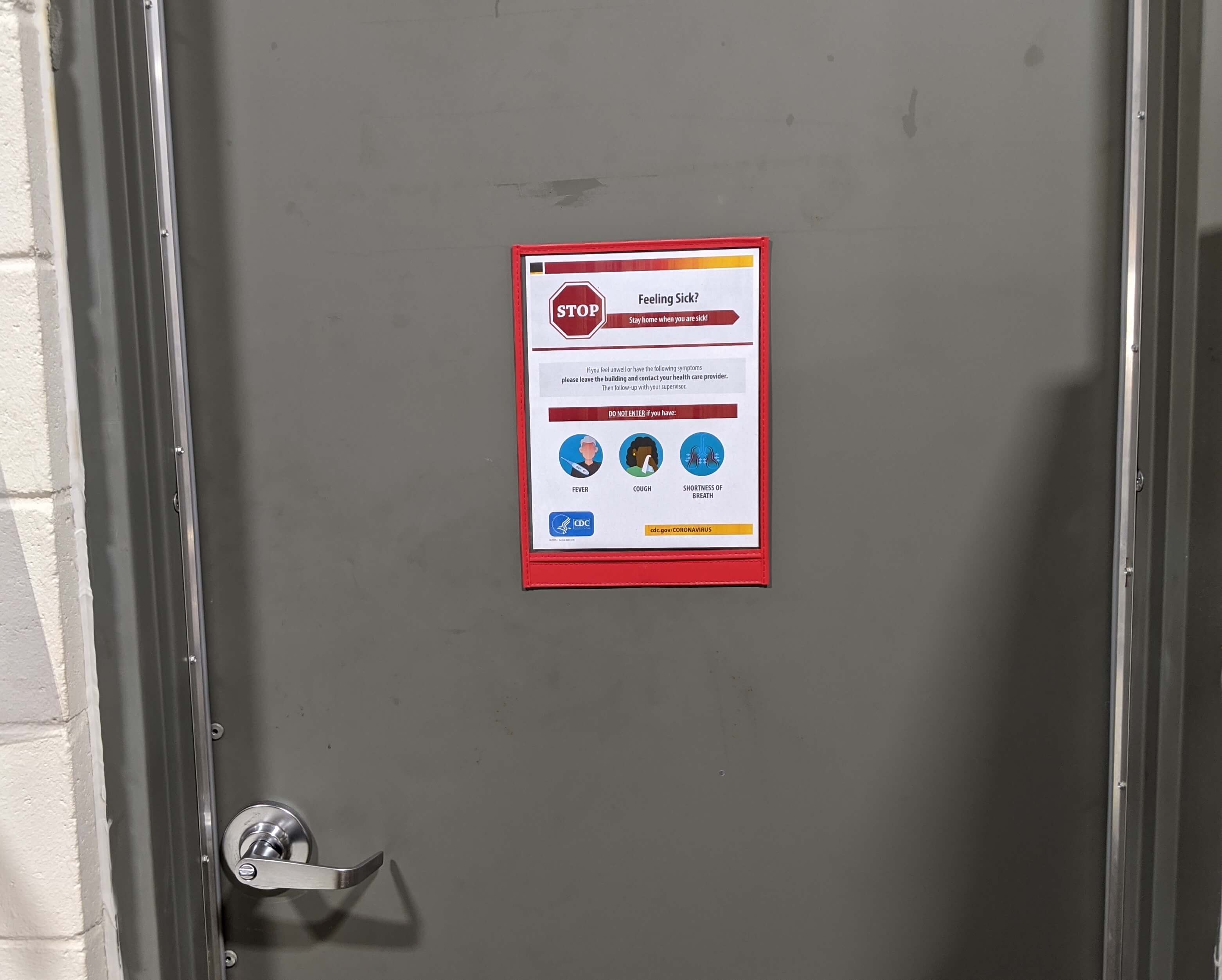
Magnetic holders are also useful for temporary signs, safety instructions, identification notices, operating procedures, and other information that needs to be moved or replaced without drilling into a door, cabinet, or equipment panel.
Tip: Mount the Opening Downward in Dusty Areas
When the holder design and document orientation allow it, a magnetic sign or document holder can sometimes be mounted with the pocket opening facing downward.
This can help reduce dust, dirt, and shop debris from settling inside the holder. The downward-facing opening may also provide some incidental protection from light splashes coming from above.
This does not make the holder waterproof. Water can still enter around the opening or edges, especially during direct spray, heavy splashing, outdoor exposure, or pressure washing.
For applications where water exposure is a primary concern, use a holder specifically designed for water resistance or waterproof protection rather than relying on mounting orientation alone.
What If the Surface Is Not Magnetic?
A non-magnetic surface does not necessarily require giving up the ability to remove or reposition the holder.
Hook-and-Loop Fasteners
Hook-and-loop fasteners, commonly known by the Velcro brand name, can provide removable mounting on many surfaces that do not accept magnets.
Examples include:
- Aluminum equipment
- Plastic machine housings
- Fiberglass panels
- Wood
- Certain painted surfaces
- Composite workstations
Hook-and-loop mounting normally requires a mating strip to be attached to the equipment or wall.
Surface cleanliness, adhesive compatibility, temperature, moisture, chemicals, load, and removal frequency should all be considered.
For many non-magnetic installations, hook-and-loop provides a useful compromise between easy removal and permanent fastening.
For Maximum Security: Eyelets, Screws, or Bolts
When easy removal matters less than attachment strength, the holder can be mechanically mounted.
One practical configuration is four corner eyelets with screws, bolts, or other suitable fasteners.
This approach may be preferable for:
- Heavy loads
- High-vibration environments
- Moving equipment
- Uneven surfaces
- Non-magnetic surfaces
- Large document pockets
- Permanent work instructions
- Locations where accidental removal would create a problem
The mounting hardware and the surface receiving the fastener must both be suitable for the application.
Choosing a Mounting Method
| Application | Typical Approach |
|---|---|
| 5–10 sheets on clean, flat steel | Standard magnetic holder |
| Larger paper packet | Increase magnetic area |
| 30–50 sheets in expandable pocket | Expandable design with additional magnetic strips |
| Heavy manual or binder | Application-specific design or reinforcement |
| Metal stencil, plate, tool, or dense object | Sample testing and application review |
| Flexible back bows under load | Consider a rigid back stiffener |
| Aluminum or another non-magnetic surface | Hook-and-loop or mechanical attachment |
| Holder needs to remain removable | Magnetic or hook-and-loop mounting |
| High vibration or very heavy load | Mechanical mounting may be preferable |
| Permanent installation | Corner eyelets with screws or bolts |
Magnet Pull Force Is Not the Same as Holder Load Capacity
Published magnetic holding-force figures are useful for comparing magnetic materials, but they do not directly tell you how much a finished document pocket can carry.
A magnetic material may be tested against clean steel with broad contact and a controlled pulling direction. A document holder in service may instead be resisting downward sliding, peeling, flexing, vibration, surface coatings, curvature, and uneven loading.
The distinction is especially important with flexible magnetic strip. Even a small gap between the magnetic backing and the steel changes the way the system performs.
For that reason, an actual holder test is usually more informative than comparing the weight of the contents with a published magnetic pull-force number.
How to Test an Unusual Application
A straightforward shop-floor test can answer questions that material specifications cannot.
- Use the actual mounting surface whenever possible.
- Clean the mounting area.
- Load the holder with the actual paperwork, binder, sample, tool, stencil, plate, or other intended contents.
- Mount it in the same position and orientation in which it will be used.
- Check whether the holder back remains flat.
- Watch for downward movement.
- Check the upper and lower edges for peeling.
- Simulate normal handling, cart movement, vibration, door movement, or equipment operation.
- Use a longer test when dropping or losing the contents could create a safety, quality, or production problem.
Testing is particularly worthwhile with unknown stainless steel, curved surfaces, machinery vibration, large expandable pockets, binders, tools, plates, stencils, and other concentrated loads.
Frequently Asked Questions
Will magnets stick to stainless steel?
Sometimes. Ferritic and martensitic stainless steels are generally magnetic. Many austenitic stainless steels provide much weaker attraction. Testing the actual surface is the simplest way to know whether it is suitable for a magnetic document holder.
Will a magnetic holder stick to aluminum?
No. Aluminum does not provide useful attraction for conventional magnetic backing. Hook-and-loop or mechanical attachment are possible alternatives.
Will a magnetic holder work through paint?
Usually, if the material underneath is strongly magnetic steel and the coating is not excessively thick. Heavy coatings, texture, rust, debris, or other gaps can reduce holding strength.
Does adding more magnetic strip always solve a load problem?
No. More magnetic area can help, but holder rigidity, strip placement, surface contact, load distribution, and vibration also matter.
How many sheets can a standard magnetic holder carry?
For an ordinary single-pocket holder on a good flat steel surface, approximately 5 to 10 sheets of ordinary paper is a useful practical range.
How many sheets can an expandable magnetic holder carry?
Expandable designs using additional magnetic strips may be configured for approximately 30 to 50 sheets of ordinary paper.
Can a magnetic holder carry tools, stencils, or metal parts?
Possibly, but those loads should be evaluated separately. Dense objects can require additional magnetic area, reinforcement, a rigid back, or a different mounting method.
Can a magnetic pocket hold a three-ring binder?
It can be possible with an appropriately designed expandable holder. Binder dimensions, loaded weight, holder rigidity, and the mounting surface all matter.
What if the back of the holder bends away from the machine?
A rigid or semi-rigid back stiffener may help keep the magnetic backing in contact with the mounting surface.
Can mounting a holder upside down help keep dust out?
Yes, in some applications. If the pocket design and document orientation allow it, mounting the opening downward can help reduce dust and debris settling inside the holder. It may also help with minor splashes from above, but it does not make the holder waterproof.
What if the equipment is not magnetic?
Hook-and-loop fasteners can provide removable mounting on many non-magnetic surfaces. For greater security, the holder can also be mounted through eyelets with screws or bolts.
Product Selection Guidance
A standard magnetic holder is usually the simplest choice when the surface is known magnetic steel, the contents are ordinary paperwork, and the pocket needs to remain removable.
When the mounting material is uncertain, test it rather than assuming that all metal or stainless-steel equipment will work.
Applications deserve closer review when the holder will carry binders, tools, plates, stencils, wood, samples, parts, or other loads substantially heavier than a small paper packet. Large holders, curved panels, vibration, and existing problems with slipping or bowing are also signs that a standard magnetic configuration may not be enough.
For non-magnetic surfaces such as aluminum, plastic, wood, fiberglass, or glass, hook-and-loop or mechanical attachment may be more appropriate.
Paper sheet counts should not be converted into a universal weight rating. A 5–10 sheet or 30–50 sheet range describes a typical paperwork application, not a certified load limit for every holder and surface.
Application and Custom Design Assistance
These principles apply broadly to magnetic document holders regardless of manufacturer. For applications outside normal paperwork use, a holder can often be adapted by changing the magnetic area, strip placement, pocket construction, reinforcement, or mounting method.
For example, TIE Office-Mates can review applications involving:
- Additional or stronger magnetic configurations
- Expandable document pockets
- Heavy paperwork packets
- Three-ring binders
- Metal stencils and plates
- Tools
- Wood or material samples
- Rigid back stiffeners
- Hook-and-loop mounting
- Four-corner eyelets
- Screw or bolt attachment
- Custom holder sizes or configurations
The most useful information for an application review is the mounting surface, holder size, intended contents, approximate loaded weight, and mounting orientation.
For a heavy or unusual application, a physical sample tested on the actual equipment is often the simplest way to determine whether the standard magnetic configuration is sufficient or the holder should be modified.
Key Points to Remember
- Magnetic document holders work best on clean, flat steel or iron surfaces with strong magnetic attraction.
- Not every metal is suitable for magnetic mounting.
- Stainless-steel compatibility varies with the type of stainless steel.
- Aluminum, copper, brass, plastic, wood, glass, and fiberglass do not provide useful attraction for conventional magnetic backing.
- Paint, coatings, dirt, rust, curvature, and other gaps can reduce magnetic holding strength.
- A typical standard single-pocket magnetic holder is generally suited to light paperwork loads of approximately 5–10 sheets.
- Expandable designs using additional magnetic strips may be configured for approximately 30–50 sheets.
- Binders, tools, plates, stencils, samples, and other dense loads should be evaluated separately.
- More magnetic material will not completely solve a load problem if the holder itself is bowing away from the mounting surface.
- A rigid back stiffener can improve contact and load distribution in demanding applications.
- Mounting a compatible pocket with its opening downward can help reduce dust entry and may provide some incidental splash protection, but it does not make the holder waterproof.
- Hook-and-loop fasteners provide a removable option for many non-magnetic surfaces.
- Eyelets with screws or bolts provide a secure mechanical alternative when quick removal is not required.
The paper-capacity examples in this article are practical application guidance, not universal certified load ratings.