
Heavy-Duty Job Ticket Holders for Industrial and Commercial Workflows
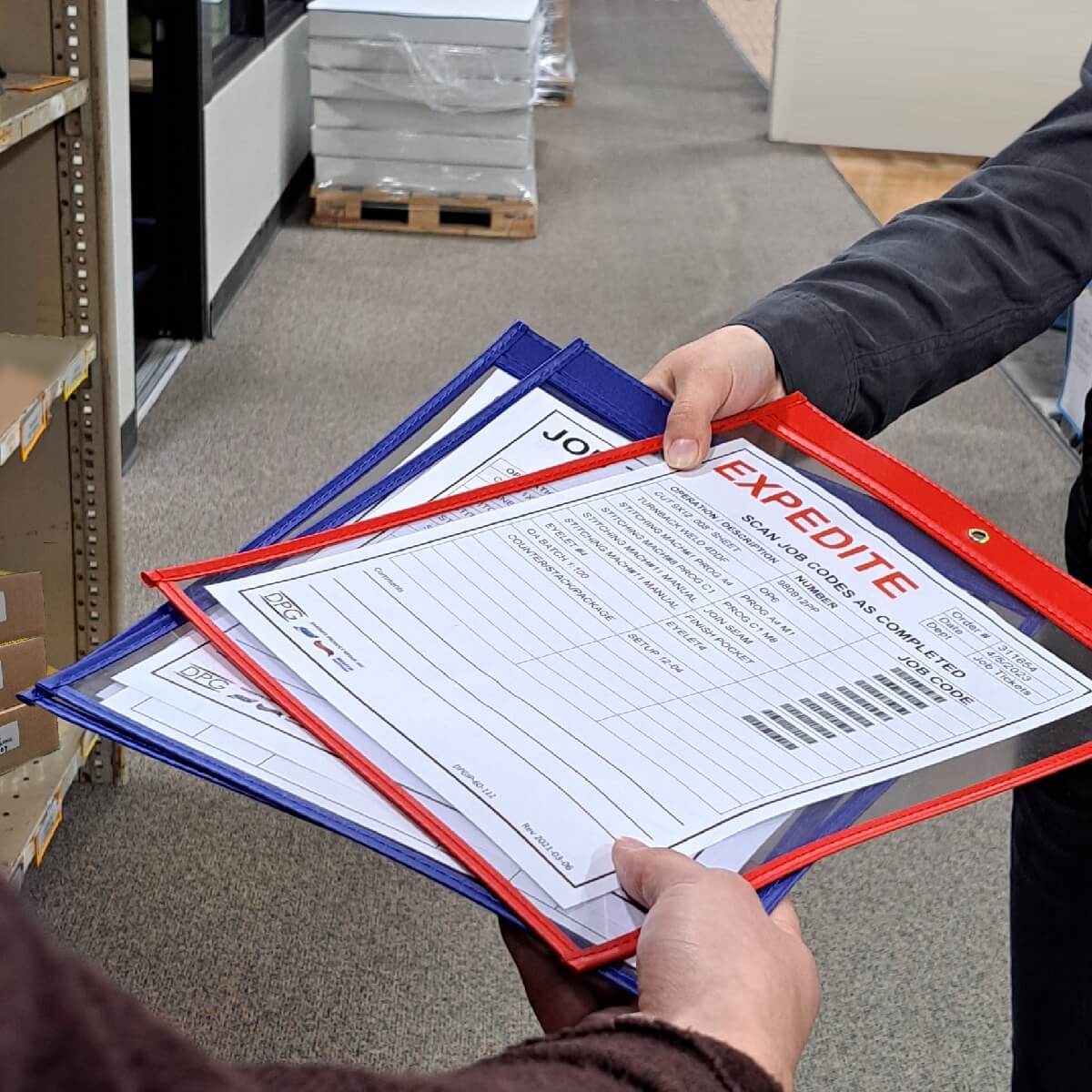
Job ticket holders help protect, organize, and display the paperwork that moves with a job, order, project, or process. In manufacturing, warehouse, construction, automotive, facilities, retail, education, and other commercial workflows, they keep work orders, travelers, inspection forms, instructions, and related documents visible where the work is being done.
TIE Office-Mates manufactures heavy-duty, USA-made vinyl job ticket holders and document holders for demanding workplace use. Depending on the product style, our holders use heavy-duty clear vinyl generally ranging from 8-gauge to 16-gauge. That heavier construction is a practical difference compared with thin, lightweight, disposable, or imported alternatives, especially in active shop, warehouse, and field environments.
What Is an Industrial Job Ticket Holder?
An industrial job ticket holder is a protective vinyl sleeve used to hold and display operational paperwork. Common examples include job tickets, shop travelers, work orders, production forms, inspection checklists, routing documents, maintenance paperwork, and instructions.
The holder keeps the document readable and easy to find while helping protect it from daily handling, dirt, dust, and shop wear. Instead of loose paperwork getting buried, damaged, or separated from the job, the holder keeps the information with the work, cart, bin, rack, workstation, or equipment where it belongs.
Common Job Ticket Holder Uses
Job ticket holders connect operational paperwork to real-world workflows, keeping important information with the physical job instead of leaving it loose on a desk, cart, bench, or workstation.
Manufacturing and Shop Floor Travelers
Use job ticket holders for production travelers, shop work orders, inspection forms, routing documents, and visual work instructions as parts, assemblies, or jobs move through different production stages.
Warehouse and Inventory Paperwork
Use document holders for warehouse pick tickets, bin labels, inventory control tags, shipping paperwork, receiving documents, and routing forms to keep fulfillment and material handling workflows organized.
Construction and Field Documents
Use job ticket holders to help protect construction schedules, site inspection checklists, permits, work orders, and field service documents from daily handling, dirt, and jobsite wear.
Automotive and Service Work Orders
Use shop ticket holders for repair orders, service checklists, inspection forms, parts paperwork, and job documents that need to stay with a vehicle, parts cart, service bay, or technician workflow.
Facilities, Retail, Education, and Healthcare Support Workflows
Use document holders for maintenance requests, retail signage, equipment status tags, cleaning schedules, facility checklists, classroom or campus paperwork, and non-patient healthcare operational forms.
Plastic vs. Paper Document Holders: Which Is Right for Your Workflow?
Plastic and paper document holders both have valid uses. The right choice depends on whether the document is being actively used, displayed, scanned, handled, transported, archived, written on, or discarded after a short cycle.
In active industrial workflows, clear plastic holders usually have the advantage because they protect documents while keeping the paperwork visible. In traditional filing, mailing, archival storage, or client-facing presentation, paper folders and envelopes may be the better fit.
When Plastic Holders Have a Clear Advantage
Clear plastic holders, including vinyl/PVC holders and polypropylene holders, are strongest when paperwork is part of an active workflow rather than a static filing system. Use a plastic document holder when:
- Moisture, grease, dirt, or dust are present: Plastic holders help protect work orders, travelers, checklists, and labels from water, oil, coolant, humidity, dirt, and general shop-floor contamination.
- The document must stay visible: Clear holders allow operators to read, verify, or scan paperwork without removing it from the holder.
- The holder will be handled repeatedly: Vinyl and polypropylene holders resist edge wear, tearing, softening, and repeated handling better than standard paper folders in active-use environments.
- The holder needs to hang: Plastic job ticket holders with eyelets, reinforced holes, straps, or other attachment options are designed for hooks, peg boards, racks, carts, cabinets, and workstations.
- The same holder will be reused: Reusable plastic holders can be relabeled, reloaded, moved, hung, and returned to service many times, which can reduce long-run cost per use in high-cycle workflows.
- Color-coded routing is needed: Color-coded borders, tinted panels, or colored backs can help teams identify departments, priorities, job types, shifts, or process stages at a glance.
When Paper Folders and Envelopes Have a Clear Advantage
Paper folders, manila envelopes, kraft envelopes, file jackets, and expanding files remain the right choice for many office, filing, mailing, and presentation uses. Use a paper folder or envelope when:
- Long-term archival storage is the goal: Acid-free archival paper is generally preferred for long-term storage of important originals, photographs, certificates, legal records, and irreplaceable paper documents.
- Direct handwriting is required: Paper folders and envelopes can be written on quickly with pen, pencil, or marker without needing adhesive labels or printed inserts.
- Lowest upfront unit cost matters most: For single-use mailing, temporary routing, or short-cycle paperwork, paper is often the lowest-cost enclosure.
- The document package is client-facing: Paper folders and file jackets often look more appropriate for proposals, legal packets, presentation folders, and front-office handoffs.
- Tabbed filing or multi-document organization is needed: Paper filing systems are designed for file cabinets, tabs, multiple related sheets, expanding files, and organized records storage.
- Paper-based recycling or biodegradability is required: Paper products may be easier to fit into standard recycling, sustainability, or green procurement programs.
Vinyl vs. Polypropylene vs. Paper
Not all plastic holders are the same. Vinyl and PVC is common for heavy-duty job ticket holders because it is clear, flexible, durable, and practical for active workplace use. Polypropylene is often preferred when buyers need a PVC-free, copy-safe, or archival-style plastic sleeve. Paper is still the better material for long-term archival paper storage, writable folders, office filing, mailing, and presentation use.
| Feature | Vinyl and PVC Holders | Polypropylene Holders | Paper Folders & Envelopes |
|---|---|---|---|
| Moisture resistance | Excellent for active-use protection | Excellent for active-use protection | Poor unless specially coated |
| Document visibility | Clear, readable, scan-through visibility | Clear, readable, scan-through visibility | Opaque; document must be removed |
| Hanging workflow use | Excellent with eyelets, grommets, straps, or reinforced holes | Good when designed with a reinforced hanging feature | Not recommended for repeated hanging |
| Exterior writability | Use labels, dry-erase notes, or printed inserts | Use labels or printed inserts | Excellent with pen, pencil, or marker |
| Archival storage | Not recommended for long-term storage of important originals | Better plastic option for copy-safe or archival-style use | Acid-free archival paper is preferred for important originals |
| Best fit | Industrial job tickets, shop travelers, work orders, outdoor and shop-floor documents | PVC-free, copy-safe, office, school, records, or archival-style sleeves | Office filing, mailing, presentation folders, short-cycle paperwork, archival storage |
Simple Rule of Thumb
Use paper when the document is being filed, mailed, presented, written on, or archived. Use plastic when the document is being worked with, moved, scanned, displayed, reused, protected, or kept with an active job.
Mounting Styles and Attachment Options
Choosing the right attachment style depends on how and where the holder will be used. Different mounting options allow paperwork to hang, attach to metal, stick to a smooth surface, travel with a cart, or fit into an organized binder system.
Hanging Eyelets
Holders with a metal eyelet are useful when paperwork needs to hang from hooks, pegs, racks, wire bins, clipboards, machinery areas, workstations, or other shop and warehouse locations.
Multiple Eyelets
Holders with two or more eyelets can provide more hanging flexibility and a more stable display, depending on the holder style, document size, and mounting hardware being used.
Hanging Strap Holders
Hanging strap holders loop over handles, bars, racks, carts, or equipment. They are useful for material handling carts, mobile jobs, rolling racks, and workflows where paperwork needs to travel with the job.
Magnetic Document Holders
Magnetic document holders are useful for attaching paperwork to compatible metal surfaces such as cabinets, machines, warehouse shelving, steel racks, rolling carts, whiteboards, and metal workstations.
Self-Stick and PSA Holders
Self-stick or PSA holders use a pressure-sensitive adhesive backing. They are useful for semi-permanent document display on smooth, clean surfaces where hanging hardware or magnets are not the right fit.
Binder Hole Options
Holders with binder holes are useful when paperwork needs to be stored in three-ring binders, reference books, job packets, training materials, or organized documentation systems while still keeping individual sheets protected.
Product Names, Size Categories, and Industry Terms
The document holder category does not have one universal naming system. The same clear vinyl holder may be called a job ticket holder, shop ticket holder, document sleeve, shop traveler holder, route traveler holder, routing card holder, work order holder, repair order holder, sign sleeve, or document protector depending on the industry and use case.
For buyers, the most reliable way to choose the right product is to start with the document size the holder needs to accept, then confirm orientation, attachment style, material, and service environment. The name matters for search and purchasing, but the physical size and workflow requirements matter most in actual use.
Tier 1: Tag and Label Holders Under 4x6
These are the smallest sleeves and are commonly used for inspection tags, status tags, RFID tags, small ID cards, shelf labels, fact tags, price tags, and equipment tags. Common terms include tag holder, label holder, fact tag holder, badge holder, card sleeve, and equipment tag holder.
Tier 2: Small Job and Shop Ticket Holders from 4x6 to 6x9
At this size, the holder begins to carry actionable paperwork rather than only identification tags. These holders are commonly used for small work orders, routing cards, half-letter forms, inspection packets, compact job tickets, and parts identification paperwork.
Tier 3: Standard Letter-Size Holders from 8.5x11 to 8.5x14
This is the most common job ticket holder range for industrial and commercial paperwork. A 9x12 holder is widely used because it fits standard letter-size forms with room to insert and remove the document. At this size, the broad product name may be job ticket holder, but industry-specific names often appear:
- Manufacturing: Shop traveler holder, route traveler holder, routing card holder, or work order holder.
- Aerospace and defense: Traveler packet holder or production traveler holder.
- Auto repair and dealerships: Repair order holder or service order holder.
- Print production: Job jacket, job folder, or production envelope.
- Facilities and maintenance: Work order holder, sign sleeve, notice holder, or instruction holder.
Tier 4: Tabloid and Ledger Holders from 11x14 to 12x18
At 11x17 and nearby sizes, the category overlaps with large job ticket holders, document holders, tabloid holders, drawing holders, and smaller blueprint holders. These sizes are useful for oversized forms, schedules, visual work instructions, engineering B-size drawings, and landscape production paperwork.
Tier 5: Large-Format Sign and Drawing Holders from 15x20 to 24x30
At larger sizes, buyers are more likely to search for sign holders, poster holders, blueprint holders, drawing holders, floor plan holders, map holders, or vinyl sign sleeves instead of job ticket holders. These products are used for large signs, construction documents, site instructions, posters, prints, maps, and floor plans.
Tier 6: Wide-Format Blueprint, Map, and Poster Holders at 22x34 and Larger
For wide-format documents such as 22x34, 24x36, 30x42, 34x44, and 36x48 sheets, common names include blueprint holder, plan holder, drawing holder, plan shield, map holder, poster sleeve, art print sleeve, and oversized document sleeve. At this scale, the main buying questions are usually document size, weather exposure, hanging method, and whether the holder needs to roll, hang, travel, or stay flat.
Orientation Matters: Portrait vs. Landscape
Across all size tiers, the same document size in different orientations can require a different physical holder because the opening, hanging location, and display direction change.
- Portrait: The holder is taller than it is wide. Example: a 9x12 holder for standard vertical letter-size paperwork.
- Landscape: The holder is wider than it is tall. Example: a 12x9 holder for horizontal checklists, spreadsheets, travelers, or work forms.
Specialty Document Holder Formats
Some workflows require more than a standard open-top sleeve. Specialty formats across the broader document holder category include:
- Above and below ticket holders: Dual-pocket holders that separate a main document pocket from a smaller secondary label, tag, or pricing pocket.
- Tote ticket holders: Holders designed to mount to reusable totes, bins, or containers instead of hanging from a hook.
- Magnetic holders: Holders with magnetic backing for compatible metal cabinets, carts, machines, racks, shelving, and whiteboards.
- Self-stick and PSA holders: Holders with pressure-sensitive adhesive for clean, smooth mounting surfaces.
- Waterproof and press-lock holders: Holders with a sealed closure for moisture, splash, dust, field, or wash-down exposure.
- Static-dissipative ESD holders: Specialty holders made for electronics manufacturing or static-sensitive environments.
Stitched vs. Heat-Welded Job Ticket Holders
Job ticket holders are commonly made using stitched or heat-welded construction. Stitched holders use stitched binding around the edges and are a strong choice for demanding industrial and commercial workflows. Heat-welded holders use welded edges and are a practical option for everyday document protection, display, and organization. The right choice depends on how often the holder will be handled, where it will be used, and how much wear the workflow creates.
Custom Sizes, Prototypes, and Production Method Choice
For standard catalog sizes, stitched and heat-welded holders can both be practical choices. The difference becomes much more important when the project involves a custom size, low quantity, unusual configuration, prototype run, large-format holder, or mixed-material construction.
Why Stitched Holders Are Usually Better for Custom Sizes
A stitched holder is made by cutting vinyl panels to the required size, applying edge binding, and sewing the assembly together with industrial thread. Changing the size or shape usually means changing the cut panel dimensions and sewing path. No custom metal die, mold, or RF welding tool is required.
That makes stitched construction a strong fit for custom holders, non-standard dimensions, low production quantities, and first-run projects where the final design is not fully proven yet. If the holder needs a special opening side, unusual pocket layout, different eyelet placement, color-coded edge trim, strap, gusset, or rigid backing, stitched construction is often the most flexible way to build it.
Why Heat-Welded Custom Holders Usually Require Tooling
A heat-welded holder is made by fusing plastic panels together along a welded seam. For RF-welded or dielectric-welded production, the seam pattern is controlled by a die or tooling fixture. That die determines the finished size, pocket shape, and seam layout.
If the desired heat-welded holder matches an existing standard die, production can be efficient and economical. If the holder requires a new size, new pocket layout, unusual shape, or special seam design, a new die may be needed before production can begin. That tooling cost and lead time usually makes heat-welded custom work better suited to proven designs and higher quantities.
Using a Stitched Holder as a Prototype Before Heat-Welded Production
For a custom holder that may eventually become a higher-volume heat-welded product, a stitched prototype run can be a smart validation step. A small stitched run can help confirm document fit, opening direction, hang hole location, pocket placement, color choice, packet thickness, and real-world usability before a buyer commits to heat-welded tooling.
This is especially useful when operators need to test the holder on an actual cart, rack, hook, bin, cabinet, workstation, or job packet. A small design error in a custom die can be expensive. A stitched prototype lets the workflow prove the design first.
Large-Format and Oversized Holders
As holder size increases, stitched construction often becomes more practical. Large-format holders for signs, drawings, maps, blueprints, floor plans, and oversized work instructions may exceed the practical size limits of standard welding equipment or require multiple welding operations. A sewing operation does not have the same platen-size limitation because the material feeds through the machine as the perimeter is sewn.
Stitched construction also creates a mechanical seam: the thread passes through the clear panels and binding, physically locking the layers together around the perimeter. For large holders that may hang from hooks, carry heavier document packets, or experience repeated handling, stitched edge construction can be a strong practical choice.
Mixed Materials and Special Back Panels
Heat-welded production works best with compatible thermoplastic films. It is not the right method for every material combination. Sewing is much more flexible because it joins layers mechanically with thread instead of relying on the materials to fuse together.
That makes stitched construction useful for custom holders that combine clear vinyl with materials such as colored vinyl backs, fabric trim, nylon webbing, pressboard, chipboard, flexible magnetic sheet, reinforced headers, foam layers, or specialty panel materials. These mixed-material builds are often difficult, costly, or impractical to reproduce with heat-welded construction.
Simple Custom-Production Rule
Choose stitched construction when the size is custom, the quantity is low, the design needs to be tested, the holder is large-format, or the configuration uses special materials, straps, pockets, gussets, or color-coded edge trim. Choose heat-welded construction when the size is standard, the design is proven, the quantity is high enough to justify tooling, a slim flat edge is preferred, or a fully sealed welded seam is required.
Industrial Stitched Job Ticket Holder Materials
Stitched job ticket holders are built from several material components working together: clear plastic panels, stitched edge binding or trim, industrial thread, and optional hardware or backing materials. Understanding those parts helps buyers compare holders that may look similar online but perform differently in actual shop, warehouse, construction, classroom, office, or commercial use.
Clear Vinyl Panels and PVC
The clear front and back panels in stitched job ticket holders are commonly made from clear PVC, also called clear vinyl. This material keeps the document, traveler, work order, checklist, or instruction sheet visible while it is inside the holder. Some stitched holders use clear panels on both sides, while other styles use a clear front with a solid or opaque back panel for contrast, color coding, or workflow identification.
Panel thickness is one of the biggest material differences between light-duty and heavy-duty holders. Lighter holders may be a good fit for short-term or disposable uses, while heavier clear vinyl is better suited for repeated handling and active industrial workflows. TIE Office-Mates stitched holders generally use heavy-duty clear vinyl in the 8-gauge to 16-gauge range depending on the specific product style.
Stitched Edge Binding and Trim
The border on a stitched job ticket holder is more than decoration. It helps join and reinforce the clear panels while also creating a visible color-coding system for departments, priorities, shifts, customers, product lines, or workflow stages.
Different manufacturers may use different trim materials. Two common approaches are smooth vinyl edge binding and woven fabric or nylon-style webbing. Neither material is automatically the right choice for every workflow. The best option depends on where the holder will be used, how often it will be handled, and what kind of dirt, wear, cleaning, or presentation requirements are involved.
- Solid vinyl edge binding: A smooth vinyl trim folded over the clear panel edges and stitched through. Vinyl trim is a strong fit for shop, warehouse, automotive, manufacturing, and other industrial environments where holders may be exposed to dust, dirt, grease, oil, or frequent handling. The smooth surface is easier to wipe clean and helps keep the holder looking professional in active work areas.
- Fabric or nylon-style webbing: A woven trim material used by some manufacturers. Webbing can provide a softer hand feel, a more flexible edge, and a less rigid or less “plastic” feel. It may be a good fit for classrooms, offices, training materials, light-duty commercial use, presentation binders, or other high-touch environments where comfort, flexibility, and appearance matter more than wipe-clean performance in dirty shop conditions.
Industrial Stitching Thread
Thread is an important part of stitched holder construction because it creates the mechanical bond around the holder edge. TIE Office-Mates stitched holders use bonded nylon thread, commonly specified as Tex 70 Government Size E. The thread is selected for industrial sewing through layered vinyl materials and is typically color-matched to the vinyl trim for a clean finished appearance.
Eyelets, Grommets, Back Panels, and Other Options
Many stitched job ticket holders include a metal eyelet or grommet so the holder can hang from hooks, pegs, racks, bins, workstations, or equipment. A common hanging hardware size in the category is a quarter-inch ID eyelet, with some styles offering larger grommet options depending on the product.
Heat-Welded Job Ticket and Document Holder Materials
Heat-welded job ticket holders are made by fusing two plastic film panels together along the edges instead of stitching them with thread. These holders may also be described as heat-sealed, RF-welded, HF-welded, dielectric-welded, or welded-edge document holders. The finished seam is usually thinner and flatter than a stitched edge, which can make welded holders easier to stack, file, store in bins, or use in high-volume paperwork systems.
Clear heat-welded holders are a more standardized product category than stitched holders. Many manufacturers use similar clear vinyl or poly film construction, so the main buying question is often less about brand-to-brand difference and more about whether the material thickness, film type, hanging style, and expected service life match the workflow.
Clear Film Thickness: Light-Duty vs. Workflow Use
Many off-the-shelf document sleeves and office-supply job ticket holders use thinner clear film, often in the 4 mil to 6 mil range, depending on the product. These can be a good choice for light-duty paperwork, short-term use, file protection, classroom handouts, office organization, temporary signage, or situations where low unit cost matters more than long service life.
Heavier welded holders are better suited when the holder is part of an active workflow instead of simple document storage. If paperwork is handled repeatedly, hung on hooks, moved with jobs, used on carts, or expected to protect work orders and travelers through multiple production steps, a heavier film and reinforced hanging method may provide better long-term value.
The practical difference is use case. A thinner sleeve may be the right business decision when the document only needs basic protection. A heavier welded holder is usually a better fit when the document needs to stay visible, protected, and attached to the job throughout daily shop, warehouse, construction, facilities, or commercial handling.
Clear Film Options: PVC vs. Polypropylene
Clear plastic holders may look similar online, but the film material can affect clarity, flexibility, cost, copy safety, and long-term document storage. The two common material categories are PVC/vinyl and polypropylene/poly.
- Standard PVC and vinyl: Clear PVC, commonly called clear vinyl, is widely used for heat-welded job ticket holders because it offers good clarity, flexibility, economical pricing, and clean welded seams. It is a practical choice for active work orders, travelers, signs, instructions, and other documents used in daily commercial workflows. PVC is generally not the best choice for long-term archival storage of important originals, photographs, or sensitive printed material.
- Polypropylene / PVC-free poly: Polypropylene is often labeled as poly, PVC-free, copy-safe, or archival-style material. It is useful when document storage safety matters more than maximum crystal clarity. Polypropylene can be a strong choice for offices, records, schools, medical administration, training materials, and applications where buyers want to avoid PVC plasticizer concerns.
Neither material is automatically best for every job. PVC/vinyl is common, clear, flexible, and cost-effective for active-use holders. Polypropylene is a better fit when copy safety, PVC-free purchasing requirements, or longer-term document storage are more important than maximum clarity or lowest material cost.
Color Coding: Tinted vs. Opaque Panels
Because heat-welded holders do not use separate colored stitched trim, color coding is usually built into the plastic panels themselves. Two common methods are tinted panels and opaque color back panels.
- Tinted panels: The holder is made from translucent colored film, so the entire sleeve carries the color. This helps teams identify priority, route, department, shift, or workflow stage from a distance. Documents remain visible through the tint, but darker colors can reduce readability.
- Opaque color backs: The holder uses a clear front panel with a solid color back panel. This can improve contrast and make the holder easy to identify from the rear or from a rack, while keeping the document fully readable from the front.
Tinted holders work well when color needs to be visible from both sides and document readability through the tint is acceptable. Opaque color backs work well when front-side readability and strong color identification are more important than seeing the document from both sides.
Welded Seams and Slimmer Edge Profile
A heat-welded seam is created by fusing the plastic panels together along the edges. There is no separate stitched trim, thread, or raised binding. This gives the holder a slimmer edge profile and can reduce bulk when holders are stacked, filed, stored in drawers, or used in large quantities.
Welded seams are often a good fit for standard document handling, moderate-use workflows, lower-cost applications, temporary paperwork, and situations where a flat edge is preferred. For rough daily handling, thick packets, repeated hanging, or long-term industrial service, stitched or reinforced styles may be the better fit.
Hanging Hardware and Hole Reinforcement
Heat-welded holders may use several hanging methods, from simple punched holes to reinforced headers and metal eyelets. The right choice depends on how often the holder will be hung, removed, re-hung, or loaded with paperwork.
- Plain punched hole: A simple die-cut hole with no added hardware. This is a low-cost option that can work well for light documents, temporary use, or low-frequency hanging.
- Reinforced molded hang hole: A thicker or reinforced header area around the hang hole. This provides more strength than a plain punched hole while keeping the holder metal-free and economical.
- Metal eyelet or grommet: A metal ring added to the header area to reduce wear from hooks, pegs, racks, or wire bins. This is useful when the holder will be hung and removed repeatedly or used with heavier document packets.
Off-the-Shelf vs. Heavy-Duty Industrial Job Ticket Holders
Not every workflow needs a heavy-duty industrial job ticket holder. For short-term, light-duty, highly disposable, or very cost-sensitive uses, lower-cost off-the-shelf holders may be the better business choice. If the paperwork only needs to last for a brief job, a temporary project, a single event, or low-handling storage, thinner holders can be a practical way to keep material cost down.
Heavy-duty industrial holders make more sense when holder failure creates larger costs than the holder itself. If the labor time spent repairing holders, replacing holders, or recovering lost paperwork begins to outweigh the upfront savings, it is usually a sign that the workflow may require a heavier stitched, heat-welded, magnetic, hanging strap, waterproof, or color-coded holder.
Color-Coded Job Ticket Holders
Color coding is a practical way to organize workflow visually. Different colored borders can help teams identify department routing, job priority, document type, production shift, customer, product line, or process stage without having to read the enclosed paperwork first.
Dry-Erase Use
Many workflows use temporary notes, status updates, check marks, routing marks, or quick job information written directly on the holder surface. Clear vinyl surfaces can support practical dry-erase use, but actual performance depends on the marker type, cleaning habits, and the conditions in the shop, warehouse, or facility.
Waterproof and Zip-Top Holders
Standard open-top holders help protect paperwork from daily handling, dirt, and general shop wear. When moisture, splashes, heavy dust, or field conditions are a concern, waterproof zip-top holders are the better choice for keeping documents more secure and protected.
Which Job Ticket Holder Should I Choose?
| Holder Type | Choose this if... |
|---|---|
| Standard Stitched Holders | You need heavy-duty document protection for active industrial and commercial workflows. |
| Heat-Welded Holders | You need practical everyday document protection for standard handling, display, and organization. |
| Archival Paper Folder or Polypropylene PP Sleeve | The document involves irreplaceable originals, photographs, legal records, or long-term storage where standard PVC is not the right fit. |
| Standard Paper Envelope, Manila Folder, or Kraft Folder | You have a single-use or short-cycle workflow where external hand-writability, lowest upfront cost, office filing, or recyclability is the primary concern. |
| Custom Stitched Holders | You need a non-standard size, low quantity, prototype run, special pocket layout, color-coded edge trim, strap, gusset, mixed materials, or large-format holder. |
| Custom Heat-Welded Holders | You have a proven design, higher quantity, existing die, slim flat edge requirement, or fully welded seam requirement that justifies tooling. |
| Magnetic Holders | You need to attach documents to compatible metal machinery, cabinets, racks, carts, or whiteboards. |
| Hanging Strap Holders | The paperwork needs to travel with carts, racks, equipment, or other mobile workflow areas. |
| Self-Stick and PSA Holders | You need a semi-permanent document display on clean, smooth surfaces where hanging hardware or magnets are not the right fit. |
| Waterproof and Zip-Top Holders | The documents may be exposed to moisture, splashes, heavy dust, or field conditions. |
| Color-Coded Holders | You want to identify departments, job priorities, document types, or workflow stages at a glance. |
| Binder-Hole Holders | You are organizing protected sheets into three-ring binders, manuals, job packets, or reference systems. |
| Large Format Holders | You are displaying oversized prints, 11x17 drawings, schedules, signs, or large visual work instructions. |
Frequently Asked Questions
Are plastic or paper document holders better?
Neither material is universally better; they serve different workflows. Plastic holders are usually the better choice for moisture resistance, repeated handling, document visibility, barcode scanning, hanging display, and active industrial use. Paper folders and envelopes are often better for archival storage with acid-free paper, direct handwriting, low-cost single-use routing, office filing, mailing, and client-facing presentation.
Why are job ticket holders called different names?
The product category lacks a universal naming standard, so the name usually depends on the industry. For example, the exact same 9x12 vinyl holder might be called a "shop traveler" in manufacturing, a "repair order holder" in auto repair, a "job jacket" in print production, or a "document sleeve" in an office setting.
What are the standard sizes for blueprint holders?
Blueprint holders are sized to fit standard architectural and engineering drawing sheets. Common sizes include 11x17 (ANSI B), 18x24 (ARCH C), 24x36 (ARCH D - the most popular blueprint size), and 36x48 (ARCH E).
When should I use a plastic document holder instead of a paper folder?
Use a plastic document holder when paperwork needs to stay visible, protected, scan-ready, attached to a job, or reusable in an active workflow. Plastic is especially useful in manufacturing, warehouse, construction, maintenance, automotive, facilities, food service, outdoor, and shop-floor environments.
When should I use a paper folder or envelope instead of a plastic holder?
Use paper when the document is being filed, mailed, presented, written on, archived, or used for a short-cycle workflow where low upfront cost matters most. For important long-term originals, acid-free archival paper or an archival-safe sleeve is usually a better choice than standard vinyl.
Is vinyl safe for long-term archival document storage?
Standard vinyl and PVC is not recommended for long-term archival storage of important originals, photographs, certificates, or sensitive paper documents. For archival storage, buyers should generally choose acid-free archival paper enclosures or appropriate archival-safe polypropylene sleeves.
When should I choose a heavy-duty job ticket holder instead of a cheaper off-the-shelf holder?
Choose a cheaper off-the-shelf holder when the use is short-term, light-duty, disposable, or very cost-sensitive, especially if occasional taping, stapling, repair, or replacement is acceptable. Choose a heavy-duty industrial job ticket holder when holder failure creates larger costs, such as lost paperwork, unclear routing, job delays, repeated handling problems, poor presentation, quality documentation issues, or the need for longer service life in an active commercial environment.
What are job ticket holders used for?
Job ticket holders are used to protect, organize, and display operational paperwork such as production travelers, work orders, inspection checklists, routing documents, inventory tags, and work instructions. They help keep information visible and connected to the physical job during manufacturing, warehouse, automotive, construction, and commercial workflows.
What is the difference between stitched and heat-welded job ticket holders?
Stitched job ticket holders use stitched binding around the edges for heavy-duty industrial and commercial use. Heat-welded holders use welded edges and are a practical option for everyday document protection, display, and organization. The best choice depends on how and where the holder will be used.
What size job ticket holder do I need?
The right size depends on the paperwork you need to hold. 9x12 is commonly used for standard letter-size documents, 12x9 is useful for horizontal forms, 6x9 works well for smaller documents or tags, and 11x17 is used for large-format prints, schedules, drawings, and signs.
What is the difference between 9x12 and 12x9 holders?
A 9x12 holder is portrait orientation and is commonly used for vertical letter-size documents. A 12x9 holder is landscape orientation and is useful for horizontally formatted checklists, spreadsheets, travelers, and work forms.
Can job ticket holders be color-coded?
Yes. Color-coded job ticket holders can help teams identify departments, job priorities, document types, production stages, shifts, customers, or product lines at a glance.
Can I write on job ticket holders with dry-erase markers?
Clear vinyl holder surfaces can support temporary dry-erase notes, routing marks, check marks, and status updates. Performance can vary depending on the marker type, cleaning habits, and shop or facility conditions, so regular cleaning is recommended.
Which job ticket holder works on metal surfaces?
Magnetic document holders are the best choice for compatible metal surfaces such as cabinets, warehouse shelving, steel machinery, rolling carts, whiteboards, and metal workstations.
Which holder is best for carts or mobile workflows?
Hanging strap holders are a strong choice for carts and mobile workflows because the strap can loop over handles, bars, racks, or equipment so paperwork can travel with the job.
What materials are used to make heavy-duty stitched job ticket holders?
Heavy-duty stitched job ticket holders are commonly made with clear PVC or vinyl panels, stitched edge binding or trim, bonded nylon thread, and optional metal eyelets or grommets. Edge trim may be made from smooth vinyl binding or woven fabric or nylon-style webbing depending on the manufacturer and intended use. Smooth vinyl trim is easier to wipe clean in dirty shop environments, while woven webbing can provide a softer, more flexible feel for cleaner office, classroom, training, or light-duty applications.
Which holder protects documents from water, dust, or dirt?
Standard vinyl holders help protect documents from handling, dirt, and shop wear. For moisture, splashes, heavy dust, or field conditions, waterproof zip-top holders are the better choice.
Are stitched or heat-welded holders better for custom sizes?
Stitched holders are usually better for custom sizes, low quantities, prototypes, unusual configurations, and large-format holders because they do not require a custom welding die. Heat-welded holders are usually better when the size and design are already proven, the quantity is high enough to justify tooling, or a slim fully welded seam is required.
Can I use a stitched holder as a prototype before ordering heat-welded holders?
Yes. A stitched prototype run can be used to test insert fit, orientation, hang hole placement, pocket layout, packet thickness, color choice, and real-world usability before committing to heat-welded tooling for a larger production run.
Why are large-format document holders often stitched?
Large-format holders can be harder to heat-weld because welding equipment has practical platen-size limits and large holders place more load on the seam. Stitched construction can handle oversized panels more flexibly and creates a mechanical stitched edge that is practical for signs, drawings, maps, blueprints, and large work instructions.
Are TIE Office-Mates job ticket holders made in the USA?
Yes. TIE Office-Mates manufactures heavy-duty vinyl job ticket holders in the USA for industrial, commercial, shop floor, warehouse, construction, automotive, facilities, and other workplace workflows.